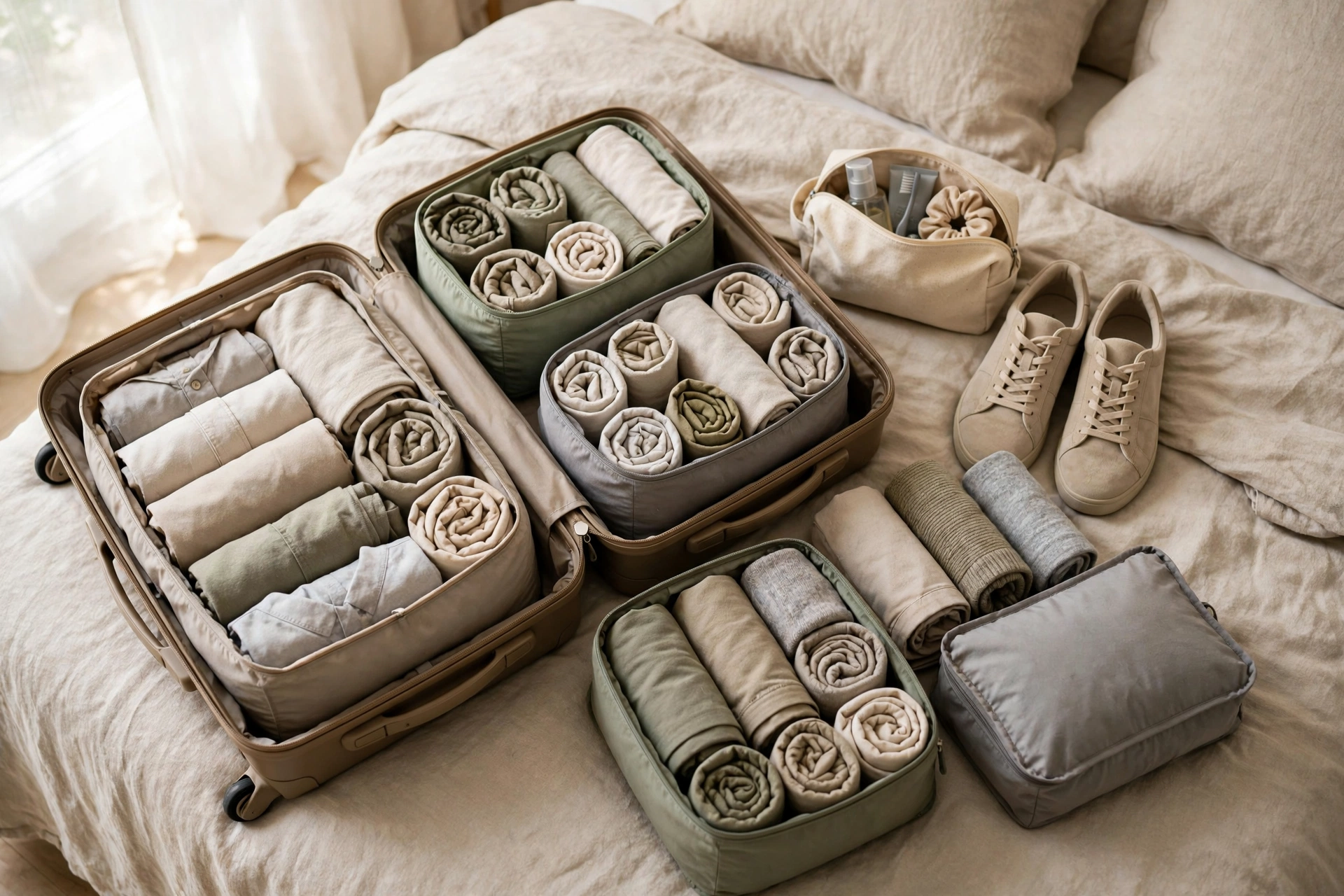
How to pack a carry-on bag for a week: a practical system that actually fits
Quick answer: How to pack a carry-on bag for a week comes down to three choices: a bag that fits your airline’s size limit, a capsule wardrobe where every piece matches, and a packing method that compresses clothes. Plan seven outfits around three bottoms, roll clothes, use packing cubes, wear your bulkiest items, and keep liquids in one quart-size bag.
Packing for a week in a carry-on sounds impossible until you try it with a system. Most people overpack because they pack for every imaginary scenario instead of the trip they have planned. A carry-on forces better decisions: no baggage claim, no checked-bag fees, and no lost luggage. This guide is written for travelers flying from the United States, where size limits and liquid rules are set by the airline and the Transportation Security Administration, so check your airline’s published limits before you leave.
What size carry-on bag do you need for a week?
For a week-long trip, most travelers do best with a carry-on in the 40 to 45 liter range, usually around 22 x 14 x 9 inches including wheels and handles. That is the standard maximum size for most major United States airlines, but budget carriers often allow less, so check your specific airline first.
A hard-shell spinner protects fragile items and keeps its shape when packed full. A soft-sided bag flexes into tight spaces and often has an expandable zipper, though that can push it over the size limit. Weight matters too: an empty bag of eight or nine pounds eats into your allowance, so look for one under seven pounds. If you are shopping, compare options first — a good overview of smart luggage solutions for your next journey covers the features that actually matter, from wheel quality to interior layout. Nearly every United States airline also allows one personal item, such as a backpack, that fits under the seat in front of you. Keep documents, chargers, medication, and a change of clothes there.
How many clothes do you actually need for seven days?
The secret to a week in a carry-on is not packing seven completely different outfits. It is packing a small wardrobe where almost every piece works with almost every other piece. Start with two neutrals, such as navy and gray, plus one accent color. When everything coordinates, five tops and three bottoms make far more than five outfits.
A practical seven-day list: four or five tops, in a mix of short-sleeve and long-sleeve; two or three bottoms, such as jeans, a lighter pair of pants, and shorts if the weather calls for them; one layer, such as a light jacket, that works over every top; seven sets of underwear and socks; one sleep outfit; and one nicer outfit if your trip includes a dinner or event. Lay it all out on your bed first and ask of each item: does this match at least two other things, and will I wear it on a specific day? If you cannot name the day and the outfit, leave it behind. For more ideas, see the guide to travel wardrobes that work from airport to adventure.
What is the best way to fold and roll clothes for a carry-on?
How you pack matters as much as what you pack. The goal is to remove air, fill every gap, and keep the bag balanced. Rolling works best for soft, casual clothes: t-shirts, knit tops, underwear, socks, and casual pants. Lay the item flat, fold it in half lengthwise, smooth out wrinkles, and roll it tightly. Rolled clothes fill corners and gaps far better than folded stacks. Folding works best for structured clothes: button-down shirts, blazers, and dress trousers. Fold them neatly and lay them flat on top.
Packing cubes are the most useful tool for a week in a carry-on. Sort clothes by type — tops in one cube, bottoms in another, underwear and socks in a small one — and compress each cube before it goes in. Cubes keep the bag organized, so you are not unpacking everything to find one shirt on day three. Pack in layers from the bottom up: heavy items go in first near the wheels, rolled clothes fill the middle, and flat items go on top. Stuff socks inside shoes to use wasted space, and leave a little room at the top — a bag packed to bursting will not close on the way home.
How do you pack toiletries and liquids for a week?
Toiletries are where carry-on packing usually goes wrong, because liquids are limited by security rules. For flights departing from the United States, the Transportation Security Administration’s 3-1-1 rule applies: each liquid container must hold 3.4 ounces (100 milliliters) or less, all containers must fit in one clear quart-size zip-top bag, and each traveler gets one bag. Keep that bag at the top of your carry-on so you can pull it out quickly at security.
Decant your regular products into small refillable bottles. A week of shampoo, conditioner, body wash, and moisturizer fits easily in 3.4-ounce bottles. Solid alternatives save even more space: bar shampoo, solid deodorant, and bar soap take up no liquid allowance at all. Toothpaste, sunscreen, and contact lens solution still count as liquids, so include them in the quart-size bag. Simplify your routine: choose multi-use products, and skip anything you can buy at your destination, since most hotels provide shampoo and body wash. Keep medications in their original labeled containers in your personal item, with a few days’ supply on the plane.
What should you wear on the plane to save space?
What you wear on the plane is free packing space. Your bulkiest shoes, heaviest jacket, and thickest sweater do not count against your bag’s weight or size when they are on your body, so wear them.
Choose your travel outfit with the same mix-and-match logic as the rest of your wardrobe. Wear the jeans that take up the most room, the shoes that are hardest to pack, and the jacket you will need at your destination. Layers help on a plane: a t-shirt under a sweater under a jacket lets you adjust to a cold cabin or a warm airport without digging through your bag. Pick soft, stretchy fabrics and shoes you can slip off easily at security. If you are flying a long distance, a little planning pays off — the guide to the best airlines for long flights covers comfort and stress-free long-haul travel, including seat choices that make a long day of flying much easier.
How do you fit shoes, tech, and extras without overpacking?
Shoes are the hardest part of carry-on packing because they are bulky, heavy, and oddly shaped. The rule is simple: wear one pair, pack one pair. For most week-long trips, that means comfortable walking shoes on your feet and one second pair — sandals, dress shoes, or trainers depending on the trip. A third pair needs a strong reason, such as hiking boots for a trail you have already planned. Pack shoes heel to toe, soles facing outward, each in a bag or shower cap to keep dirt off your clothes. Stuff the insides with socks, and place shoes at the bottom near the wheels, where their weight keeps the bag stable.
Tech needs its own plan. A laptop, tablet, charger, and cables can add several pounds, so bring only what the trip requires. One multi-port charging brick usually replaces three separate chargers. Keep your laptop or tablet in your personal item so you can take it out quickly at security. For extras, use the same test as for clothes: name the day you will use it. A book for the flight, a reusable water bottle, and a laundry bag are all reasonable. Keep valuables close — cameras, jewelry, documents, and electronics belong in your personal item. The guide to solo travel safety and what actually matters on the road explains how to keep important items secure.
How can you keep clothes fresh for a full week?
Seven days in one small bag means clothes get worn more than once, and that is normal. The trick is choosing fabrics that keep things fresh. Merino wool, linen blends, and good synthetic activewear resist odor far better than heavy cotton, and they dry quickly if you need to wash them. Dark colors hide small marks better than white or pale pastels.
Plan a mid-trip laundry stop. Most week-long trips have a natural break — a hotel laundry room, a laundromat near your stay, or a sink and a few hours to air-dry. Washing a few items halfway through effectively doubles your wardrobe. When choosing where to stay, the guide on how to choose the right accommodation for extended stays covers amenities, including laundry access, that make a longer trip comfortable. A small laundry bag keeps dirty clothes separate from clean ones. Hang clothes up as soon as you arrive: gravity and fresh air remove most wrinkles within a few hours. Staying healthy helps too — drink water, get outside in daylight, and keep a roughly normal sleep schedule. For a fuller plan, see the guide to travel wellness and maintaining health and energy across time zones.
What mistakes make a carry-on too heavy or too full?
Most carry-on failures come from the same few mistakes. The first is packing for “just in case” — the extra jacket for weather that is not forecast and the dress shoes for a dinner that is not planned. If an item has no specific day and purpose, leave it behind. The second is packing full-size toiletries. A full-size shampoo bottle can take up the space of two rolled t-shirts, and it will be confiscated at security.
The third mistake is ignoring the weight limit. Some airlines, especially on international routes, weigh carry-on bags at check-in or at the gate. Weigh your packed bag on a bathroom scale before you leave: step on holding the bag, then without it, and subtract. If it is over the limit, move heavy items into your personal item or wear them. The fourth is packing without a system — clothes tossed in loose fill a bag in minutes and wrinkle badly. The fifth is forgetting the return trip: souvenirs need space too, so leave a small gap or pack a lightweight foldable tote for the way back.
Which packing method saves the most space?
Different methods suit different trips. This table compares the most common approaches.
| Method | Best for | Space saved | Wrinkles | Effort |
|---|---|---|---|---|
| Rolling clothes | T-shirts, knits, casual pants, underwear | High | Low for soft fabrics | Medium |
| Flat folding | Button-down shirts, blazers, dress trousers | Medium | Low for structured items | Low |
| Packing cubes | Keeping outfits organized for a week | Medium to high | Low, clothes stay compressed | Low once packed |
| Compression bags | Bulky sweaters, jackets, cold-weather trips | Very high | Medium, can crease cotton | Medium |
| Bundle wrapping | Wrinkle-free shirts around a soft core | Low | Very low | High |
For a typical week-long trip, the best combination is rolling soft clothes inside packing cubes, with one or two structured items folded flat on top. Compression bags are worth it mainly for cold-weather trips, where a sweater would otherwise take up a quarter of the bag.
Frequently asked questions
Can you really pack for a week in just a carry-on?
Yes, for most trips. A 40 to 45 liter carry-on holds seven days of clothes if you pack a mix-and-match capsule wardrobe, roll soft clothes, use packing cubes, and wear your bulkiest shoes and jacket on the plane.
What size bag is best for a week-long trip?
A bag around 22 x 14 x 9 inches, or 40 to 45 liters, is best for most travelers flying from the United States. It is the standard maximum carry-on size for most major airlines and large enough for seven days of clothes. Always check your airline’s exact limits first.
How many outfits should I pack for seven days?
Pack around five tops and three bottoms that all coordinate, plus one layer and one nicer outfit if your trip needs it. Each top works with each bottom, so that makes far more than five outfits. Add seven sets of underwear and socks.
Do packing cubes actually save space?
Yes. Packing cubes compress clothes and remove air, and they save time by keeping the bag organized. Compression cubes with a second zipper save the most space. You can find what you need without unpacking the whole bag.
What toiletries can I bring in a carry-on?
You can bring liquids, gels, and creams in containers of 3.4 ounces (100 milliliters) or less, all fitting in one clear quart-size zip-top bag, under the Transportation Security Administration’s 3-1-1 rule. Solid toiletries such as bar shampoo and bar soap do not count.
What should I do if my carry-on is too heavy at the gate?
Move heavy items into your personal item, which is rarely weighed, and wear your heaviest jacket and shoes. If the bag is still over the limit, ask the gate agent about your options.
Packing a carry-on for a week is a skill, and it gets easier each time you do it. The first trip takes an hour of planning. The second takes half the time, because you already know which clothes earn their place. Start with the system in this guide and enjoy walking off the plane with everything you need — no baggage claim, no waiting, and nothing to lose.