Thorong Peak Climbing vs. Chulu Far East: Which 6,000m Peak Should You Choose?
Reaching a 6,000-meter summit in Nepal is the dream of a lot of trekkers and beginner mountaineers. These peaks provide the experience of high-altitude mountaineering without the high degree of technical challenge of climbing 7,000 meters or 8,000 meters. Out of the numerous alternatives in Nepal, Thorong Peak Climbing and Chulu Far East Climbing are two good and satisfying ones in the Annapurna region.
These two peaks stand at an altitude of more than 6,000 meters and offer breathtaking Himalayan scenery, cultural experiences, and adventure.
It is not always easy to decide between these two peaks, though. The same is the question which many climbers turn their eyes to, Thorong Peak Climbing vs. Chulu Far East, which one is more suitable for me? This question is answered depending on your level of experience, physical fitness, technical skills, availability of time and personal goals.
This step-by-step report will enable you to appreciate the factual differences between Thorong Peak Climbing and Chulu Far East Climbing to make the correct choice.
Understanding 6,000m Peak Climbing in Nepal
Before comparing Thorong Peak Climbing vs. Chulu Far East, it is important to understand what a 6,000-meter peak means in Nepal. Trekking peaks are mountains with altitudes of 6,000 meters (19,685 ft) to 6,500 meters (21,325 ft). They are controlled by the Nepal Mountaineering Association and can usually fit well with climbers who have good experience in trekking, as well as basic training in mountaineering.
These peaks are referred to as trekking peaks, but they cannot be underestimated. Real challenges are altitude sickness, cold weather, glaciers, snow slopes and long summit days. Both Thorong Peak Climbing and Chulu Far East Climbing demand acclimatisation, physical fitness and mental strength.
Introduction to Thorong Peak Climbing
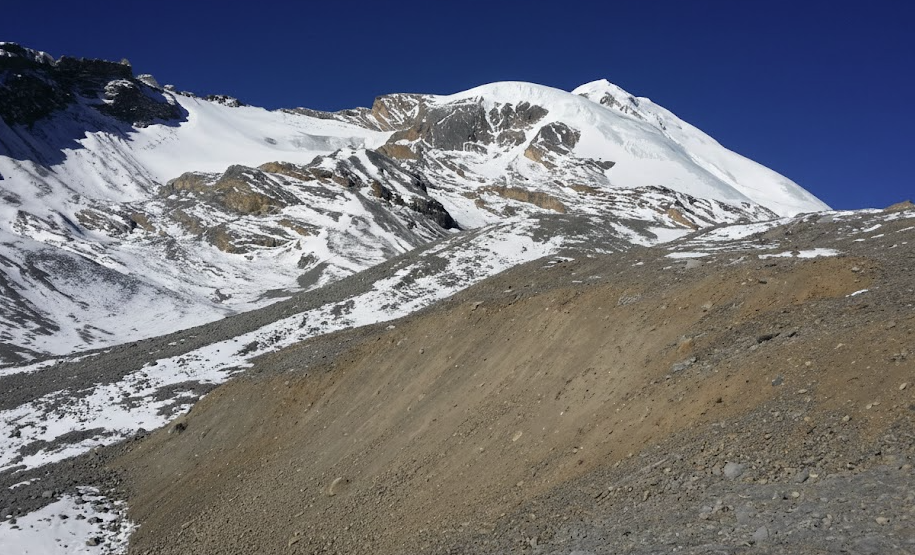
Thorong Peak is at an altitude of 6,144 meters (20,157 ft). It is above the renowned Thorong La Pass in the Annapurna area. The Thorong Peak Climbing goes hand in hand with the Annapurna Circuit Trek, and this makes it a highly competitive choice for trekkers who would like to venture into mountaineering.
Thorong Peak Climbing has the best combination of high altitude trekking and non-technical climbing. The summit is not technical, and would still give the experience of applying crampons, ice axes, and ropes.
Due to its position next to Thorong La Pass at 5,416 meters (17,769 ft), it can be acclimated comparatively easily under the condition that the itinerary is planned properly.
Introduction to Chulu Far East Climbing
Chulu Far East is one of the three Chulu peaks, and the other two are Chulu West and Chulu Central. Chulu Far East Climbing will bring you to the heights of 6,059 meters (19,879 ft). It is situated within Manang Valley, Annapurna region, bordering the Annapurna Circuit trail.
Chulu Far East Climbing is usually regarded as a little more technical than Thorong Peak Climbing. It takes a glacier route, snow slopes, and the use of fixed ropes in some cases, depending on the conditions. Chulu Far East Climbing is a popular choice among many climbers who decide to become serious mountaineers after doing high-altitude treks.
Location and Accessibility Comparison
Location is also a significant factor when comparing the Thorong Peak Climbing vs. the Chulu Far East. Thorong Peak is very near to Thorong La Pass, which is one of the major attractions of the Annapurna Circuit. This allows Thorong Peak Climbing to be the perfect adventure destination for trekkers who have already decided to cross Thorong La at 5,416 meters (17,769 ft).
Chulu Far East Climbing is a place just partly off the Annapurna Circuit route. Starting at Manang village at about 3,540 meters (11,614 ft), the climbers must go off course to Chulu base camp. This gives it an additional number of days and involves greater logistical planning than the Thorong Peak Climbing.
Regarding accessibility, Thorong Peak Climbing tends to be more accessible and simpler to combine with a more traditional trekking trail, whereas Chulu Far East Climbing seems more of a climbing expedition.
Elevation and Altitude Challenge
One of the factors that is of greatest importance in high mountain climbing is the altitude. The Thorong Peak is 6,144 meters (20,157 ft), and Chulu Far East is 6,059 meters (19,879 ft). Even though the elevation gap is minimal, 85 meters (279 ft), the elevation obstacle is a bit different on both peaks.
Thorong Peak Climbing is also advantaged by slow acclimatisation since the trekkers tend to pass between Thorong La Pass on the way to or the way out of the Thorong Peak. Sleeping in high villages such as yak kharka in altitude of about 4,050 meters (13,287 ft) and Thorong phedi in altitude of 4,540 meters (14,895 ft) assists the body to adjust itself.
There is also good acclimatisation provided by Chulu Far East Climbing, particularly rest days in Manang at 3,540 meters (11,614 ft). The ascendancy is, however, steeper in the snow higher up, which may seem challenging, despite the peak being a notch lower.
Technical Difficulty and Climbing Skills Required
Technical difficulty is one of the largest questions in Thorong Peak Climbing vs. Chulu Far East. Generally, Thorong Peak Climbing is not a technical one. It is a snow slope route with a bit of glacier walking, although steep ice climbing is not common. The essential skills of mountaineering, like crampons, an ice axe and walking on snow, are generally sufficient.
Chulu Far East Climbing is a little bit more technical. The last summit push can be characterised by steeper snow and ice. Fixed ropes might be required by climbers, and even more significant is the teamwork of the ropes. Although highly technical skills are not a prerequisite, past snow and ice climbing experience would be highly beneficial.
Thorong Peak Climbing is usually suggested as the first 6,000-meter top to those who are beginners. Chulu Far East Climbing suits the individuals who have prior experience in high altitude trekking or climbing.
Route and Itinerary Differences
Thorong Peak Climbing is commonly done in the Annapurna Circuit path, which passes through villages such as Chame, Pisang, Manang, Yak Kharka and Thorong Phedi. The base camp is established close to Thorong Phedi or High Camp at approximately 4,925 meters (16,158 ft). The summit day is not very lengthy, however, straightforward and the same day a return to camp.
Chulu Far East Climbing entails walking across the Manang Valley, and then moving onto the Chulu base camp at an approximate altitude of 4,900 meters (16,076 ft). A high camp typically is set up at an elevation of approximately 5,300 meters (17,388 ft). The summit day is more challenging and mostly involves travel on glaciers at early morning.
Comparing Thorong Peak Climbing vs. Chulu Far East, Thorong Peak is usually easier and has a more straightforward approach, whereas Chulu Far East needs more of an expedition planning.
Scenic Beauty and Mountain Views
Thorong Peak Climbing and Chulu Far East Climbing are both breathtaking locations. The climbers have panoramic views of Annapurna I, 8,091 meters (26,545 ft), Dhauligiri 8,167 meters (26,795 ft), Manaslu 8,163 meters (26,781 ft) and numerous other Himalayan giants in Thorong Peak.
Chulu Far East Climbing offers breathtaking scenery of the Annapurna II of 7, 937 meters (26, 040 ft), Annapurna III of 7, 555 meters (24, 787 ft), Gangapurna of 7, 455 meters (24,459 ft), and Tilicho Peak of 7, 134 meters (23, 406 ft). The prospect of the top of Chulu Far East is rather confined and dramatic because of the presence of other peaks.
Thorong Peak Climbing and Chulu Far East both offer very highly in the area of natural beauty.
Physical Fitness and Endurance Requirements
These two climbs demand physical fitness, nevertheless, with a slight variation. Thorong Peak Climbing is characterised by lengthy trekking days and extremely lengthy summit day; however, the terrain is not as technical. Strength is less important than endurance and stamina.
Chulu Far East Climbing requires stamina and power. Physically more difficult are carrying gear to elevations and walking through snow, along with more acute slopes. The climbers should be able to be comfortable with early starts and extended time on the snow and ice.
Best Season for Each Climb
Thorong Peak Climbing and Chulu Far East Climbing are better during the spring season between March and May and the fall season between September and November. It is also during these seasons that weather conditions are more stable, skies are clearer, and temperatures are manageable.
Thorong Peak Climbing during spring is beautiful with snowy backgrounds, whereas in autumn, there are clear skies and the trails are drier. Chulu Far East Climbing is also very good during both seasons, although when the snow melts in the springtime, the climb can get technical.
Cost and Logistics Comparison
Thorong Peak Climbing is comparatively cheaper. The reason is that it can be extended to the Annapurna Circuit trek, and there is no need to have additional camps and equipment.
Chulu Far East Climbing is usually more expensive since more days of climbing, more camps, and more usage of technical equipment. Safety needs more personnel and logistics.
Safety and Risk Factors
In both climbs, safety is a significant issue. Common risks include altitude sickness, changes in weather and physical fatigue. Thorong Peak Climbing has less objective risk as the path is not as technical and closer to the existing trekking paths.
Chulu Far East Climbing is a little riskier with glacier passage and steep, higher mountains. There must be proper guides, good equipment and weather awareness.
Who Should Choose Thorong Peak Climbing?
Thorong Peak Climbing is a perfect destination for trekkers who would like to get their first Himalayan summit at more than 6,000 meters (19,685 ft). It suits well people who have already been on high-altitude hikes and wish to make a transition into mountaineering without encountering severe technical difficulties.
Who Should Choose Chulu Far East Climbing?
Chulu Far East Climbing provides more opportunities to those climbers who have some experience working with snow and ice. It is a great option when one would like a more challenging and rewarding climb and remain at the trekking peak level.
Final Verdict: Thorong Peak Climbing vs. Chulu Far East
In the case of Thorong Peak Climbing vs. Chulu Far East, there is no right answer. Thorong Peak Climbing is easy, accessible, and it is good for beginners. Chulu Far East Climbing is more challenging, technical and more challenging for climbers who want a more powerful challenge.
Both the peaks are unforgettable Himalayan experiences, breathtaking scenery and a sense of accomplishment. The decision to do it or not should be based on your experience, confidence, fitness level and the type of adventure you seek.
Eventually, whichever peak you prefer between Thorong Peak Climbing or Chulu Far East Climbing, you will look back at a peak of 6000 meters in Nepal and will never forget the feeling.
Disclaimer
The information provided in this article, “Thorong Peak Climbing vs. Chulu Far East: Which 6,000m Peak Should You Choose?”, is intended for general informational and educational purposes only. While every effort has been made to ensure accuracy, climbing conditions, routes, technical difficulty, weather patterns, costs, and safety requirements can change due to seasonal variations, environmental factors, government regulations, and individual circumstances.
High-altitude mountaineering involves inherent risks, including altitude sickness, extreme weather, physical injury, and other potential hazards. This article should not be considered professional mountaineering, medical, or safety advice. Readers are strongly advised to consult licensed trekking or climbing agencies, certified guides, and medical professionals before planning any high-altitude expedition.