
How to Access Expert Keratoconus Treatment in Adelaide Today
If you or a family member have been diagnosed with keratoconus, the most critical takeaway in 2026 is that modern treatment in Adelaide is no longer just about “coping” with blurry vision; it is about stabilising the eye to prevent permanent damage. Because keratoconus is a progressive condition where the cornea thins and bulges, early intervention is the absolute key to avoiding a future corneal transplant.
Adelaide has a world-class reputation in corneal health, housing some of the nation’s leading specialists and the Australian Corneal Graft Registry. Here is how you can navigate the path from diagnosis to advanced treatment.
1. Accessing Care: The Clinical Pathway in Adelaide
Accessing expert care in Adelaide typically involves a coordinated effort between a specialised optometrist and a corneal surgeon.
The Diagnostic Assessment
Your first step is often with an optometrist who specialises in corneal mapping. General eye exams can sometimes miss early-stage keratoconus, as the symptoms mimic standard astigmatism. In Adelaide, clinics like Innovative Eye Care (with locations in the CBD and Henley Beach) use advanced diagnostic tools like the Oculus Pentacam and Corvis ST.
These devices do more than just check your prescription; they create a 3D “tomographic” map of your cornea, measuring the thickness and shape of both the front and back surfaces. This allows for the detection of “subclinical” keratoconus—the stage before your vision even begins to noticeably fail.
Specialist Referral
If progression is confirmed, you will be referred to an ophthalmologist (eye surgeon) specialising in the “Anterior Segment” or Cornea. Notable specialists in Adelaide with extensive keratoconus expertise include:
- Associate Professor Michael Goggin (Ashford Advanced Eye Care)
- Dr Simone Beheregaray and Dr Ben LaHood (Adelaide Eye & Laser Centre)
- Dr Jern Yee Chen (Eyemedics)
- Dr Swati Gupta (iVision Laser)
2. Adelaide Cross-Linking Eye Surgery (CXL)
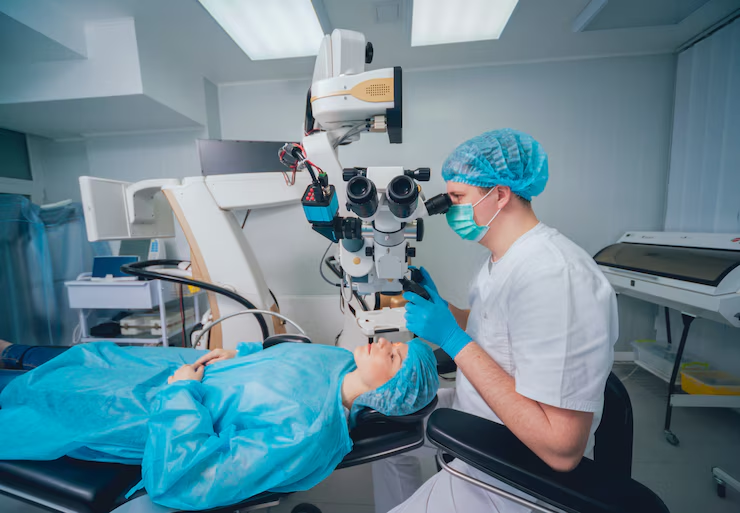
Corneal Collagen Cross-Linking (CXL) is the only treatment proven to stop keratoconus from getting worse. For patients seeking Adelaide cross linking eye surgery, this procedure “stiffens” the corneal tissue using Vitamin B2 (Riboflavin) drops and ultraviolet light, creating new chemical bonds between the collagen fibres to stabilize the eye.
What to Expect During the Procedure
In Adelaide, CXL is performed as a day procedure, usually taking about 30 to 60 minutes per eye.
- Epithelium-Off (The Gold Standard): Most Adelaide surgeons prefer the “epi-off” method, where the thin outer layer of the cornea is gently removed to allow the Riboflavin to penetrate effectively. This has the highest long-term success rate (over 90% stability).
- Recovery: Your eye is numbed with drops during the procedure, so it is painless at the time. However, expect 3–5 days of discomfort (feeling like a severe scratch) as the surface cells grow back. Adelaide clinics typically provide “bandage” contact lenses and anaesthetic drops to manage this phase.
3. Treatment Costs and Medicare Rebates
One of the biggest advantages for Adelaide patients is that keratoconus treatment in Adelaide is medically recognised and well-supported by the Australian healthcare system.
Medicare Support (MBS Item 42652)
Since 2018, Corneal Collagen Cross-Linking has been covered by Medicare for patients with documented progression.
- The Rebate: Medicare provides a substantial rebate for the procedure. The schedule fee is approximately $1,399.90, and patients often receive a rebate of roughly $1,050 to $1,300 per eye.
- Out-of-Pocket Costs: In a private Adelaide clinic, the total cost before the rebate typically ranges from $2,500 to $3,500 per eye. After the Medicare rebate, many patients end up paying an out-of-pocket “gap” of between $1,200 and $1,800.
Private Health Insurance
Because CXL is considered a medically necessary surgery rather than elective cosmetic surgery, most private health insurers will cover the “hospital” portion of the costs if the procedure is done in a private facility like Ashford Hospital or The Memorial Hospital.
4. Beyond Surgery: Vision Correction Options
Stopping the progression with cross-linking is only half the battle. To see clearly, many Adelaide patients require specialised optics that glasses simply cannot provide.
- Scleral Lenses: These are the current “gold standard” for vision. They are large-diameter lenses that vault over the irregular cornea and rest on the white of the eye. They create a perfectly smooth new surface for light to enter.
- KeraRings / Intacs: These are tiny plastic inserts placed inside the cornea to flatten the “cone” shape. Adelaide surgeons often combine these with cross-linking to improve the eye’s base shape.
- Topography-Guided PRK: In specific cases, a laser can be used to “smooth” the corneal surface at the same time as cross-linking.
5. Why Early Intervention Matters
In the past, many keratoconus patients eventually required a corneal transplant. However, data from the Australian Corneal Graft Registry (based at Flinders University) shows that the number of transplants for keratoconus has dropped significantly since the introduction of cross-linking.
By accessing treatment in Adelaide today, you are choosing to stop the disease in its tracks. If you are noticing frequent changes in your glasses prescription or “ghosting” around lights at night, seeking a tomographic scan is the most important step you can take.
Disclaimer
The information provided in this article is intended for general educational and informational purposes only. It is not a substitute for professional medical advice, diagnosis, or treatment. Keratoconus is a medical condition that requires individual assessment by a qualified eye care professional. Always consult a licensed ophthalmologist, optometrist, or other qualified healthcare provider regarding any questions or concerns you may have about your eye health, treatment options, or eligibility for procedures such as Corneal Collagen Cross-Linking (CXL). Outcomes may vary between patients, and the information on costs, Medicare rebates, and private insurance coverage is provided as a general guide and may change over time. The author and publisher disclaim any liability for decisions made based on the content of this article.