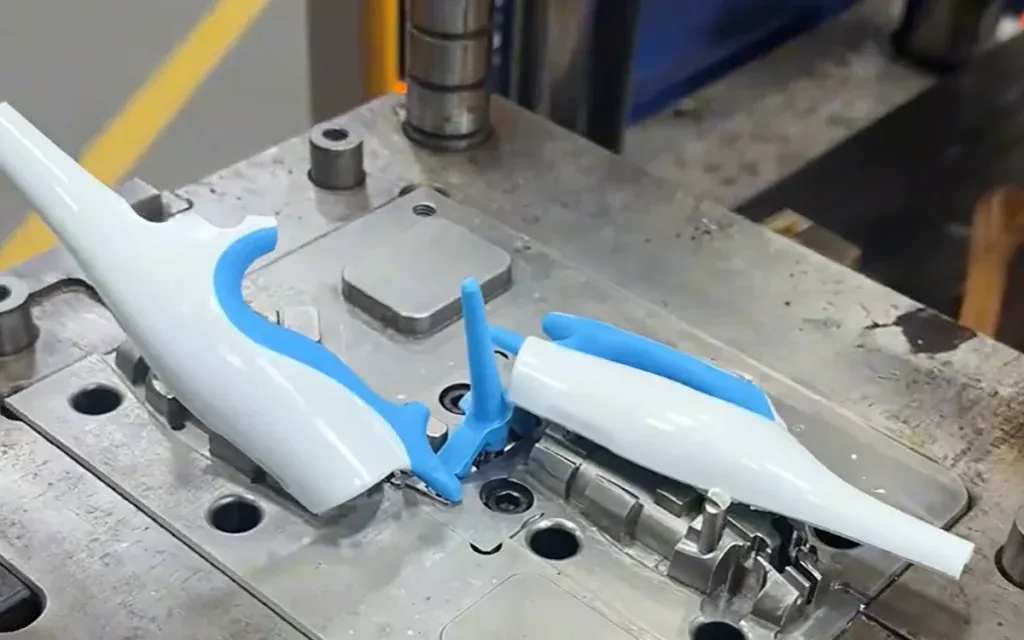
From Prototype to Production: How EvokPoly’s Overmolding Services Scaled a Automotive Startup to $50M Revenue
Manufacturing startups in the automotive sector face a persistent challenge: transitioning from functional prototypes to production-ready components that meet the demanding requirements of vehicle manufacturers. The gap between proof-of-concept and scalable manufacturing often determines which companies survive their first major supply contracts and which fail to deliver on early promises.
This transition becomes particularly complex when products require multiple materials, precise tolerances, and the durability standards expected in automotive applications. A single component failure can cascade through entire production lines, creating costly delays and damaging relationships with automotive OEMs who operate on tight schedules and zero-defect expectations.
The automotive industry’s shift toward electric vehicles and advanced driver assistance systems has intensified these pressures. Components must now integrate multiple functions while maintaining the reliability standards that have defined automotive manufacturing for decades. For startups, this means finding manufacturing partners who understand both the technical requirements and the commercial realities of scaling production.
Understanding Multi-Material Component Manufacturing
Multi-material manufacturing combines different polymers, metals, or composite materials into single components through specialized processes. Overmolding services represent one of the most versatile approaches to this challenge, allowing manufacturers to bond dissimilar materials in ways that create stronger, more functional parts than single-material alternatives.
The process works by molding one material over or around another, creating mechanical and sometimes chemical bonds between the materials. This approach eliminates the need for secondary assembly operations, reduces the total number of components in a product, and often improves the final part’s performance characteristics.
In automotive applications, this capability proves especially valuable for components that must provide multiple functions. Seals that combine rigid structural elements with flexible sealing surfaces, electrical connectors that integrate conductive and insulating materials, and interior components that combine aesthetic surfaces with functional substrates all benefit from multi-material manufacturing approaches.
Material Compatibility and Bonding Mechanisms
Successful multi-material components depend on understanding how different materials interact at their interface. Some material combinations create strong mechanical bonds through interlocking surface geometries, while others rely on chemical adhesion between compatible polymer families.
Thermoplastic elastomers often bond well with rigid thermoplastics when both materials share similar chemical structures. Polyolefin-based materials generally bond effectively with other polyolefins, while engineering plastics like nylon or polycarbonate require specific elastomer formulations to achieve reliable adhesion.
Temperature management during the molding process affects bond strength significantly. The substrate material must remain stable at the temperatures required to process the overmolded material, while the new material must flow properly without degrading the existing component.
Design Considerations for Production Scalability
Components designed for overmolding must account for the thermal and mechanical stresses that occur during manufacturing. Sharp corners and thin sections in the substrate can create stress concentrations that lead to part failure during or after the overmolding process.
Draft angles become more critical in overmolded parts because the materials may have different shrinkage rates as they cool. Parts with inadequate draft angles may bind in the mold, causing surface damage or dimensional variations that affect fit and function in the final assembly.
Wall thickness transitions between different materials require careful consideration to ensure proper flow and avoid defects like short shots or sink marks. Uniform wall thickness in the overmolded material helps ensure consistent cooling and reduces the likelihood of internal stresses that could cause premature failure.
Production Scaling Challenges in Automotive Manufacturing
Automotive manufacturers operate under different constraints than most other industries. Production volumes can shift dramatically based on vehicle sales, seasonal demand, and model year transitions. Components must perform consistently across temperature ranges from arctic cold to desert heat, often for decades of service life.
Quality standards in automotive manufacturing reflect these demanding conditions. ISO/TS 16949 requirements establish quality management systems specifically for automotive suppliers, emphasizing defect prevention, variation reduction, and continuous improvement throughout the supply chain.
For startups entering automotive supply chains, these standards represent both a barrier and an opportunity. Companies that can demonstrate consistent quality and reliable delivery schedules gain access to high-volume, long-term contracts. Those that cannot meet these standards find themselves excluded from automotive opportunities.
Volume Flexibility and Production Planning
Automotive production schedules change frequently based on market conditions, warranty issues, and supply chain disruptions. Suppliers must be able to adjust production volumes quickly while maintaining quality standards and cost targets.
Overmolding operations can provide advantages in this environment because they reduce the number of individual components that must be managed, inventoried, and assembled. Fewer parts mean fewer potential points of failure in the supply chain and reduced complexity in production planning.
However, multi-material processes also require more sophisticated process control and quality monitoring. Each material in the component may respond differently to environmental conditions, processing variations, and aging effects. Successful scaling requires understanding these interactions and building appropriate controls into the production process.
Quality Control and Testing Protocols
Multi-material components require testing approaches that evaluate both individual materials and their interfaces. Bond strength testing becomes critical for overmolded parts, particularly in applications where the bond line experiences mechanical stress during normal use.
Thermal cycling tests help identify potential failures that could occur over the lifetime of automotive components. Materials with different thermal expansion rates may develop interface stresses during temperature changes, leading to delamination or cracking over time.
Chemical resistance testing ensures that automotive fluids like oils, coolants, and cleaning chemicals will not degrade the component materials or their interfaces. Many automotive environments expose components to multiple chemicals simultaneously, creating potential interactions that may not be apparent from single-chemical tests.
Cost Management and Manufacturing Economics
The economics of overmolding operations differ significantly from single-material processes. Higher tooling complexity and longer cycle times must be balanced against reduced assembly costs and improved part performance. For automotive applications, these trade-offs often favor overmolding approaches when production volumes justify the initial investment.
Material costs in overmolded components reflect not just the raw material prices but also the compatibility requirements between different materials. Specialized grades of elastomers designed for bonding with specific thermoplastics typically cost more than general-purpose materials, but they provide more reliable production outcomes.
Labor costs often decrease with overmolding approaches because fewer assembly operations are required. Components that would otherwise require multiple parts, adhesives, and assembly steps can often be produced in single molding operations, reducing handling and quality control requirements.
Tooling Investment and Amortization
Overmolding tools require more sophisticated design and construction than single-material molds. Multiple injection systems, precise alignment mechanisms, and often more complex cooling systems increase initial tooling costs significantly.
However, these higher tooling costs can be amortized over the improved functionality and reduced assembly costs of the final components. For automotive applications with multi-year production runs, the tooling investment often pays back within the first year of production.
Tool maintenance requirements also differ for overmolding applications. Multiple materials may create different wear patterns on mold surfaces, and the thermal cycling between different processing temperatures can affect tool life. Preventive maintenance programs must account for these additional complexity factors.
Supply Chain Integration
Overmolding services require coordination between multiple material suppliers, each with their own quality specifications and delivery requirements. Supply chain disruptions affecting any one material can shut down production of the complete component.
Material inventory management becomes more complex because different materials may have different shelf lives, storage requirements, and quality control procedures. Some elastomers require specific humidity or temperature conditions for storage, while engineering thermoplastics may be sensitive to moisture absorption.
Supplier qualification processes must evaluate not just individual materials but also their interactions in the final component. Changes in raw material suppliers can affect bond strength, appearance, or performance characteristics, even when the materials meet identical specifications.
Technology Integration and Process Optimization
Modern overmolding operations benefit from advanced process monitoring and control systems that track parameters across multiple injection systems. Real-time monitoring of temperatures, pressures, and flow rates helps identify process variations before they affect part quality.
Automation plays an increasingly important role in overmolding operations, particularly for automotive applications where consistency and repeatability are critical. Robotic handling systems can maintain precise positioning between molding steps and reduce the risk of contamination or damage to partially completed parts.
Process optimization in overmolding requires understanding the interactions between different processing parameters and their effects on final part properties. Changes in injection speed, pressure, or temperature for one material may affect the quality of previously molded materials, creating complex optimization challenges.
Quality Monitoring and Process Control
Statistical process control methods in overmolding must account for the multi-variable nature of the process. Traditional control charts may not adequately capture the interactions between different materials and processing steps.
Non-destructive testing methods help monitor bond quality without destroying parts. Ultrasonic testing can detect delamination or void formation at material interfaces, while thermal imaging can identify processing variations that might affect long-term performance.
Data integration systems that combine information from multiple sensors and testing stations provide better insight into process performance than individual measurement points. These systems can identify correlations between processing parameters and final part quality that might not be apparent from single-variable analysis.
Conclusion
The transition from prototype to full-scale automotive production requires manufacturing approaches that can deliver consistent quality, volume flexibility, and cost effectiveness simultaneously. Multi-material manufacturing through overmolding provides a pathway for startups to create differentiated products while meeting the stringent requirements of automotive supply chains.
Success in this transition depends on understanding the complex interactions between materials, processes, and quality requirements that define automotive manufacturing. Companies that invest in proper process development, quality systems, and supply chain management can leverage these capabilities to build sustainable competitive advantages in demanding markets.
The automotive industry’s continued evolution toward more complex, multi-functional components creates ongoing opportunities for manufacturers who can master these multi-material processes. As vehicle designs become more sophisticated and performance requirements continue to increase, the ability to combine different materials into optimized components becomes increasingly valuable for both startups and established suppliers.