Mount Kailash Tour 2026 New Routes, Travel Rules & Updated Conditions
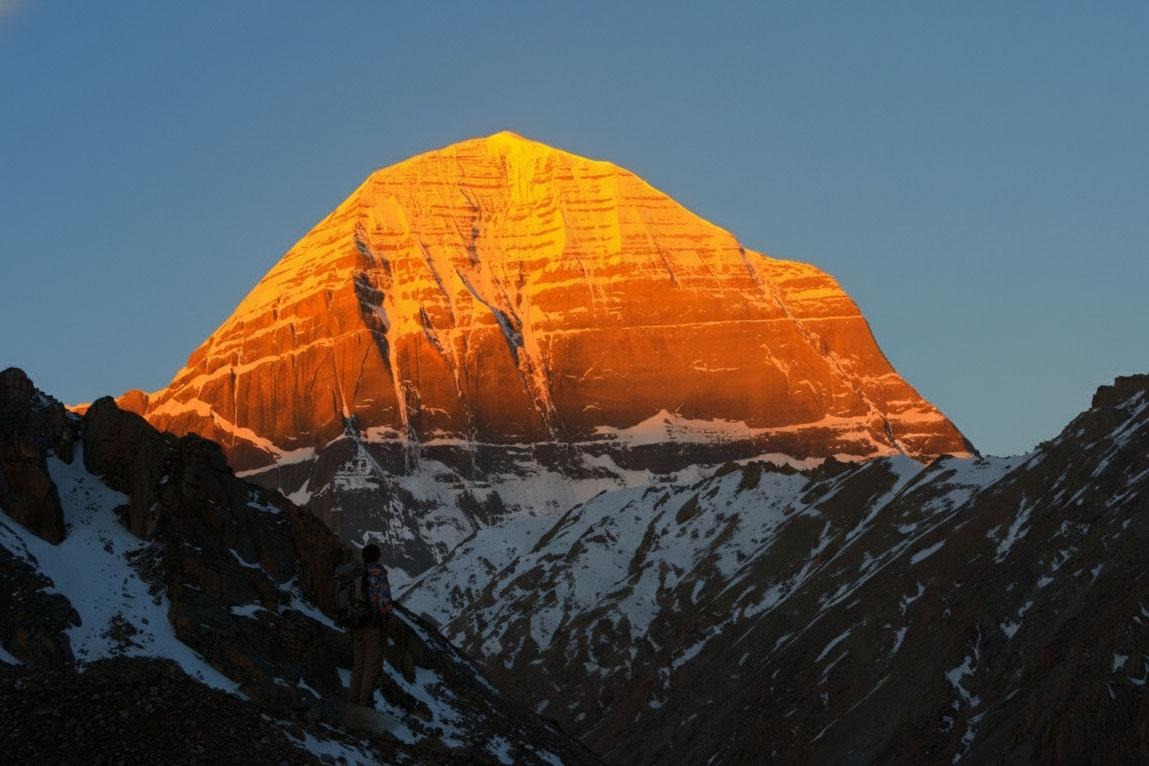
The spiritual geography of Asia has a special position occupied by Mount Kailash and Lake Mansarovar. To Hindus, Mount Kailash is the heavenly home of the supreme ascetic, Lord Shiva and a divine goddess, Parvati. Completion of the Kailash Parikrama, or going around the mountain, is also regarded as one of the most potent devotional practices and is thought to purify spiritually.
Buddhists also consider Kailash to be Mount Meru, the axis of the universe, where the world rotates, thus making it important in meditation and pilgrimage. It is believed by Jains that their Tirthankara, Rishabhadeva, received liberation here, and the people in the ancient religion of Bon view the mountain as the spiritual heart of the religion.
At the base of the Kailash is Lake Mansarovar, created, supposedly, by Lord Brahma, and representing purity and divine consciousness. Taking a ritual bath or praying around the lake is reported to purify any bad karma and cause inner change.
Reopening of the Yatra and the 2026 Season
This Kailash Mansarovar Yatra was postponed for a several years after 2019 because of the COVID-19 pandemic and geopolitical conflict between India and China. Its partial re-opening in 2025 was a significant diplomatic and cultural achievement, which allowed access to one of the most significant pilgrimage locations for millions of followers.
In 2026 routes, quotas and operating conditions will be based on bilateral clearances as well as on-the-ground conditions in the border/road conditions; the travelers are supposed to check the latest rules by using the licensed operators as well as official road/border notices near the departure.
Kailash season is either at the end of spring time (late May to early October) or in May to September (Depending on weather conditions and road conditions).
In winter, beyond this window especially, there is heavy snowfall, freezing temperatures and hazardous road conditions, which make travelling very hard and hazardous.
Nepal Route Options
The Nepal route is still the most accommodating and most internationally approachable route to Mount Kailash. The majority of pilgrims will start off by flying to Kathmandu, the capital of Nepal, at which point documentation and permits are completed, and they move on to the Tibet border.
In Nepal, there are two principal building gateways, which are Rasuwagadhi-Gyirong (Kerung) and Kodari-Zhangmu in the Nyalam County. In July 2025, Rasuwagadhi Friendship Bridge was washed away by flooding and this disrupted the movement hence travelers should ensure that they confirm the active crossing on their dates.
Helicopter services have emerged as one of the greatest inventions in recent years. Nepalgunj to Simikot and Hilsa flights enable pilgrims to save themselves the lengthy and physically challenging road travel.
Such helicopter conveyance helps a lot in saving time and body weight; thus the pilgrimage has become accessible to old travelers and those with health restrictions.
The alternative that is equally popular is the flight from Kathmandu to Lhasa and further, via Tibet by land, to Mount Kailash. This is a special route where pilgrims can make visits to significant Tibetan cultural and religious places like the Potala Palace, Jokhang Temple, and monasteries in Shigatse, then move to the west.
It is a deeper cultural and spiritual excursion and is especially attractive to those tourists interested in Tibetan Buddhism and history.
Indian Routes
There are also the direct government-controlled routes to Tibet by Indian pilgrims. Nathu La Pass is the least trekked trail by pilgrims in the Sikkim state, extending into Tibet, which means the pilgrims can drive all the way through Gangtok to the Nathu La Pass, with minimal walking. In the Uttarakhand-Lipulekh route, one traverses a more conventional route along the Indian Himalayas with road transport and a trek, then heads into Tibet.
These paths are controlled by the Indian government, and they entail online registration, medical tests, and the procedure of allocation of seats so that the pilgrims can be safe and there is an equitable distribution of scarce seats.
Airport Developments and Infrastructure
In Tibet and Nepal, the development of infrastructure has made access to the Kailash region much easier. With the opening of Ngari Burang Airport or Ali Pulan Airport, it is now possible to fly directly into western Tibet, thus the travel time and fatigue are saved.
It is linked to Ngari Gunsa Airport, which allows quicker links between Lhasa and the Kailash region. On the Nepal side, Nepalgunj and Simikot airports are important ports of helicopter flights and regional flights that cater for the pilgrimage traffic into the Himalayas highlands.
Travel Rules, permits and documentation
Travelling to Mount Kailash is highly controlled by the Chinese government, and all travellers entering Tibet from Nepal Group Visa and permits are arranged with the help of authorized tour operators. It is necessary to have a Chinese Group Visa, which is issued solely at the Chinese Embassy in Kathmandu.
Moreover, to visit certain restricted areas, including Mount Kailash and Lake Mansarovar, pilgrims will have to take a Tibet Travel Permit and an Alien Travel Permit. Independent travel is not allowed, and the itineraries have to be pre-approved and followed rigidly.
Health, Safety and Fitness Requirements
Due to the extremely high altitude of Mount Kailash, health and safety laws are very stringent. Pilgrims also have to provide medical certificates that they are fit to travel to high altitudes. Patients who have heart disease, severe asthma, or a chronic blood pressure issue could be advised against participation.
Whereas the helicopter and the overland tours have no strict age restrictions, trekking paths demand that the participants are physically fit and able to walk long distances at an altitude. To prevent altitude sickness and hypothermia, one needs to acclimatize and hydrate appropriately.
Ritual Timing and Kailash Parikrama.
Kailash Parikrama: This is a trek which is 52 kilometres around the mountain and is normally spanned over three days. The hardest part is Dolma La Pass at around ~5,630 meters, where oxygen is low and one cannot predict the weather in the future.
To accomplish the parikrama, one needs strength of body, will and devotion. A lot of pilgrims plan their trip according to the full moon dates, as they are regarded as particularly good and spiritually strong.
Conclusion
The Mount Kailash tour 2026 is a new era in the history of this ancient pilgrimage. The borders are open, the routes are extended, the infrastructure is enhanced, helicopters are also available, the travel rules are also clearer, and still, the spiritual nature of the journey is not lost.
Having the right planning, observing the local laws and customs and preparing both physically and psychologically, pilgrims will be able to safely and meaningfully take this sacred journey and make the experience that not only will be transformative but will remain memorable.
Disclaimer
The information provided in this article, “Mount Kailash Tour 2026: New Routes, Travel Rules & Updated Conditions,” is intended for general informational and educational purposes only. While every effort has been made to ensure accuracy based on available sources at the time of writing, travel regulations, route accessibility, border conditions, permit requirements, health guidelines, and infrastructure developments related to the Mount Kailash and Lake Mansarovar Yatra are subject to change without prior notice due to weather conditions, government policies, diplomatic relations, and local circumstances.
Readers are strongly advised to verify all details—including visas, permits, routes, medical requirements, and travel feasibility—through official government notifications, embassies, and licensed tour operators before making any travel plans. This article does not constitute legal, medical, or professional travel advice.