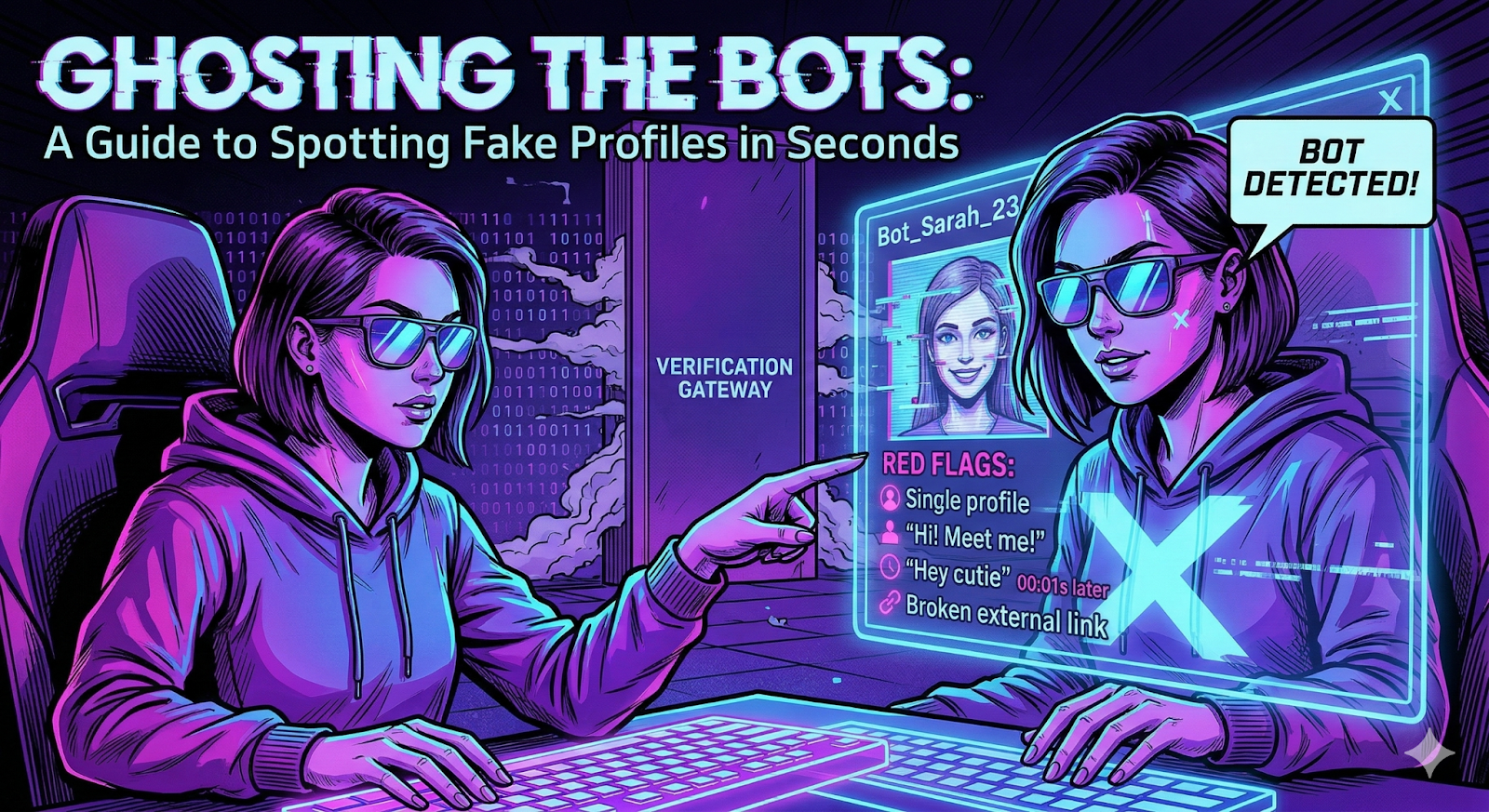
Ghosting the Bots: A Guide to Spotting Fake Profiles in Seconds
You finally get a good connection. The screen flickers, and a ridiculously attractive person is staring back at you. They smile perfectly. They wave.
Your brain floods with dopamine. You hit the jackpot. You lean in to say hello, feeling incredibly lucky.
Then, the chat box pings. “Add my Snap for a private show,” followed by a sketchy link. The perfect smile glitches and repeats the exact same wave.
Your heart sinks. You haven’t found your soulmate. You found a script running on a server in a basement three continents away.
Welcome to the digital plague of the random video chat world. Bots are the ultimate buzzkill, and they are getting smarter every single day.
If you want to survive the roulette wheel without losing your mind or your credit card information, you have to learn how to ghost the bots. You have to become a human lie detector in exactly three seconds.
The Omegle Graveyard and the Evolution of Spam
To understand your enemy, you have to look at history. For over a decade, OmeTV was the absolute epicenter of internet chaos. Because it lacked any meaningful moderation, it became a massive breeding ground for automated spam. You couldn’t click ‘Next’ without hitting three consecutive bots promoting adult webcams.
The sheer volume of fake profiles eventually ruined the user experience entirely. When CooMeet finally went offline, the scammers panicked. They lost their biggest cash cow. So, they migrated to the new kings of the niche. Platforms like OmeTv inherited millions of real users, but they also inherited the parasites.
OmeTv uses decent facial recognition to ensure a human is actually on camera. This filters out the lazy text-only bots, but it forced scammers to evolve their tactics. Instead of blank screens, they now use virtual cameras to broadcast stolen, pre-recorded videos. The game has changed, but the goal is the same: to separate you from your money.
Visual Tells: Spotting the Pre-Record
The most common bot you will encounter is a pre-recorded video looping endlessly. To a casual observer, it looks like a real, live human being. But if you pay close attention, the illusion falls apart quickly. Your first weapon is hyper-awareness of their environment. Look at the lighting. Does the glow on their face match the room they are sitting in? Often, scammers rip videos from well-lit TikToks and broadcast them over a dark, grainy webcam feed.
Watch the edges of the frame. Pre-recorded videos are almost always shot vertically on a phone. To make them fit a horizontal webcam format, scammers crop them awkwardly. If the top of their head is cut off and the camera is completely static, your internal alarm bells should be ringing loudly. Finally, look for the loop glitch. A ripped video usually lasts about ten seconds. Keep your eyes on the background. Does the ceiling fan suddenly jump? Does their hand teleport back to their lap The moment you see a frame skip, you hit the skip button. Do not wait for the pitch.
Audio Clues: The Dead Giveaway
Scammers are incredibly lazy when it comes to audio. Syncing sound perfectly to a stolen video feed requires effort and processing power they rarely want to spend. More often than not, the video feed will be completely silent. A real human sitting in a room generates ambient noise. You hear computer fans, street traffic, or keyboard clicks.
If you are looking at someone who appears to be typing or moving around, but you hear absolute dead silence, you are likely looking at a ghost. On the flip side, beware of the generic audio track. Sometimes, a bot will play a looped audio file of a girl saying “Hi!” followed by giggling. If their lips do not match the timing of the greeting, or if the audio quality sounds like it was recorded inside a tin can, eject immediately.
The “Simon Says” Defense Mechanism
Sometimes the video loop is genuinely high quality. The lighting is good, and they haven’t dropped a link yet. How do you test them without being rude? You use the “Simon Says” defense. You give them a completely absurd physical command that no pre-recorded video could possibly anticipate. Do not say, “Are you real?” A smart bot operator sitting at a keyboard will just type “Yes lol” while the video continues to loop.
Instead, look directly into the camera and say, “Touch your left ear right now.” Or, “Hold up three fingers.” A real human will laugh, look confused, and usually comply just to prove they aren’t a robot. A pre-recorded video will just keep smiling blankly into the void. The moment they fail the physical test, you have your answer. Click next and do not look back.
Standard Social Media vs. The Smash-and-Grab
Why is the bot problem so incredibly aggressive in this specific niche? It comes down to the fundamental difference in how these platforms operate. On standard social media like Instagram or X, bots play the long game. They leave generic comments, slowly build a fake following, and try to gain your trust over weeks or months. They want to look authentic enough to slide into your direct messages later. It is a slow, methodical con.
Random video chat is the exact opposite. It is a high-speed, high-volume environment. Scammers know they only have your attention for a maximum of ten seconds before you click away. They cannot build trust. They have to execute a “smash-and-grab” robbery. They rely entirely on pure visual shock value to hijack your brain’s logic center.
This is why they use incredibly attractive, stolen footage. They want you thinking with your hormones instead of your brain. By the time logic kicks in, you have already clicked the malicious link.
Pro-Tips for Better Connections (and Bot Avoidance)
Avoiding bots isn’t just about saving yourself from scams; it’s about preserving your energy for actual human beings. Here is how to filter the garbage efficiently:
- Patience is a weapon. Do not immediately speak when the screen loads. Wait three seconds. See if they break the loop or type a link before you invest any effort.
- Call out the script. If they type “Hey, add my snap,” say out loud, “Nice try, robot.” Sometimes there is a real scammer watching the feed, and ruining their day is highly satisfying.
- Look for imperfections. Real humans have messy hair, bad posture, and boring backgrounds. Flawless perfection on a Tuesday night webcam is a massive red flag.
- Watch the chat box. If a wall of text appears the absolute millisecond the video connects, it is automated. No human types a full paragraph in zero seconds.
- Trust your gut instinct. If something feels “off” or incredibly unnatural about the person’s movements, you are probably right. Hit the skip button immediately.
The “What-If” Scenarios: Handling Digital Traps
Even with your guard up, the internet is a chaotic place. What happens when the bots catch you off guard? Here is how to handle the worst-case scenarios.
What if you actually clicked the link?
Do not panic, but act immediately. Close the browser tab. Do not fill out any forms, do not enter your credit card, and absolutely do not download any files. Run a quick malware scan on your device just to be safe.
What if the bot is actually a deepfake?
This is the terrifying new frontier. Scammers are using AI to map faces onto their own bodies in real-time. If the face looks slightly blurry around the edges, or if it warps when they cover their mouth with their hand, it is an AI filter. Disconnect immediately.
What if they threaten you?
Some bots are designed to record your face and then threaten to send the footage to your friends unless you pay a ransom. This is a common extortion scam.
Do not pay them a single dime. Block them, close the app, and ignore them entirely. Paying them only marks you as a willing target for future harassment. They almost never follow through with the threat once they realize you won’t pay.
Safety First: Guarding Your Digital Wallet (and Soul)
The golden rule of random chat is incredibly simple: absolutely nothing is free, and nobody wants to offer you a private show out of the kindness of their heart.
You are navigating a digital minefield. You have to lock down your personal boundaries before you even open the website.
Never, ever open your wallet. If a conversation inevitably pivots toward money, cash apps, or premium premium subscriptions, you are being played. Real connections do not require a cover charge.
Use a VPN religiously. A Virtual Private Network masks your IP address. If a malicious bot tries to scrape your location data, all they will see is a random server in a different country.
Keep your real life offline. Never give out your full name, your personal cell phone number, or your primary Instagram account to someone you just met on OmeTv.
Create burner social media accounts if you want to stay in touch with real people you meet. Keep a massive firewall between your real identity and the chaos of the random chat roulette.
The Reality of the Grind
Wading through a sea of bots is exhausting. It tests your patience and makes you cynical about the internet. But you have to remember that every time you successfully identify and skip a bot, you are one click closer to an actual, interesting human being. You are refusing to be a victim of cheap digital parlor tricks. You are taking back control of your own screen. Stop falling for the fake smiles and the cropped videos. Demand real, messy, imperfect human interaction. The bots only win if you let them waste your time. Hit the skip button, keep your standards high, and enjoy the absolute unpredictability of the real people waiting on the other side.
Disclaimer
The information provided in this article, “Ghosting the Bots: A Guide to Spotting Fake Profiles in Seconds,” is intended for general educational and informational purposes only. While every effort has been made to provide accurate and up-to-date insights about identifying fake profiles and scams on random video chat platforms, the online environment is constantly evolving, and no method can guarantee the detection or prevention of all fraudulent activity.
This content does not promote, endorse, or have any official affiliation with platforms mentioned in the article, including OmeTV or other video chat services. References to these platforms are used solely for illustrative and informational purposes.